 Telephone: +86-574-62838966
 E-mail : sale2@hengboyi.com


 en
 English
 Español
 中文简体

Paper Lantern Lights: A B2B Sourcing Guide for Event and Landscape Buyers
Content
- 1 Paper Lantern Lights Are a Shade, Not a Lighting System
- 2 Sizing, Spacing and Socket Choices That Decide the Final Look
- 3 Weather, Fire Safety and Compliance for Outdoor Paper Lantern Lights
- 4 Powering Paper Lantern Lights: Solar, Mains and Hybrid Layouts
- 5 What Buyers Actually Weigh When They Place a Paper Lantern Light Order
- 6 Customization: Voltage, Cable, Length and Packaging
- 7 Where Paper Lantern Lights Work Best
- 8 Paper Lanterns, Lantern-Style String Lights or Plain Festoon?
- 9 Quality Control and Delivery: What to Ask Before You Commit
- 10 Frequently Asked Questions About Paper Lantern Lights
- 10.1 Are paper lantern lights suitable for outdoor use?
- 10.2 What lamp base should I specify for paper lantern lights?
- 10.3 How many paper lantern lights do I need for a given length?
- 10.4 Can paper lantern lights run on solar power?
- 10.5 What is the difference between paper lantern lights and lantern-style string lights?
- 10.6 Can a supplier customize voltage, cable length and packaging?
- 10.7 What certifications should a paper lantern light supplier provide?
- 10.8 How can I reduce fire risk in indoor installations?
- 11 Related Resources and Next Steps
A hotel group in Rotterdam ordered 600 white paper lantern lights for a courtyard relaunch in late spring. The shades arrived on schedule, the paper was clean, and the production run matched the sample photographs. The problem surfaced two days before the opening: the cord sets in the shipment were indoor-rated, the plugs were the wrong regional type, and the sockets sat so deep inside the 25 cm frames that every bulb was half-buried behind the ribs.
The lesson is simple. Paper lantern lights are a lighting system made of two halves, and the half that fails is almost never the paper. The shade sets the look. The socket, cable, bulb, controller and power source decide whether an installation survives a season, a certification review and a repeat order.
This guide is written from the manufacturing side of that equation. Ningbo Hengboyi Lighting has been developing and producing string lights and solar lighting since 2003 for lighting brands and manufacturers around the world, and the questions that arrive from buyers are rarely about paper. They are about lamp bases, wattage, cable compounds, IP ratings, packing and lead time. Below we cover sizing and spacing, weather and compliance, power options, the criteria that actually decide a purchase order, customization limits, and the quality checks worth writing into a contract. A short FAQ at the end collects the questions that come up most often in sourcing conversations.
Paper Lantern Lights Are a Shade, Not a Lighting System
Strip a paper lantern light down to its parts and you find five components: the paper shade, the rib or frame that holds its shape, a top ring and a bottom ring, a socket with a bulb, and the cable or string that carries power to that socket. Buyers who focus only on the first three frequently end up with a beautiful shade and an installation that cannot pass an inspection.
The socket is where most specification errors begin. Small lanterns with openings under 30 mm usually take an E12 candelabra base, the same base used by C7 and small G40 bulbs. Medium and large lanterns generally use E26 or E27, which covers G45, S14, ST38 and A60 shapes. When a project calls for a particular bulb shape, the socket and the lantern ring diameter have to be checked together, because a socket that fits the ring can still leave the lamp sitting so deep in the frame that it throws almost no light onto the paper.
Wattage matters more inside a paper shade than in almost any other fixture. Incandescent bulbs at 25 W to 40 W were the default twenty years ago and still appear in old installation guides. In an enclosed paper lantern they concentrate heat around the glass envelope, and paper is a material that will scorch long before it burns. A 1 W to 3 W LED replacement produces a comparable decorative glow with a fraction of the heat, which is why modern decorative string lights are built around these low-wattage lamps.
Construction type decides how the installation is maintained. An integrated string light has the bulb and socket sealed as one unit, which means fewer failure points and a lower cost per light, but a damaged lamp means replacing that section of the run. A detachable, pendant-type socket lets maintenance staff swap a single bulb from a step ladder without touching the cable. Hotels, restaurants and rental companies usually specify detachable sockets for any installation that runs longer than a few weeks.
Spacing is the other half of the look. Individually corded lanterns rarely hang at even intervals, because each cord is cut and tied by hand on site. A factory-produced festoon string with fixed socket spacing holds the rhythm of the design from the first lantern to the last. Five metre strings with ten lights, which works out at 0.5 metre centres, are the most common format for decorative schemes of this type, and they are easy to join when a longer run is needed.
Control options should be decided early as well. Steady warm white suits quiet hospitality spaces. Colour with RGB synchronisation suits event and festival work. Infrared remote control and pixel-level control suit installations that change mood by the hour, such as retail windows and stage sets, where a single controller can drive several strings in sequence.
Specify the shade and the electrical half in the same document. Diameter, socket base, bulb wattage, spacing and control type are one decision, not five separate ones.
Sizing, Spacing and Socket Choices That Decide the Final Look
Lantern diameter sets the visual weight of an installation, and the numbers are more predictable than they first appear. A 25 cm paper lantern reads as a soft, personal light at 2.2 metres above a table. The same lantern hanging at 4 metres above a courtyard floor reads as a small white dot. Sizing is therefore a function of viewing distance rather than a matter of taste, and the diameter should be chosen after the mounting height is fixed.
Hanging height has a practical floor. The bottom of a lantern at 2.1 metres clears most adult heads; doorways and service corridors want 2.4 metres or more. Over dining tables, 0.75 to 0.9 metres between the table surface and the bottom of the lantern keeps light out of guests' eyes while still illuminating the table.
Spacing follows intent. Centres of 0.4 to 0.5 metres create the dense canopy look that photographs well in wedding and event work. Centres of 1.0 to 1.2 metres create an airy, architectural line that suits restaurant terraces and retail corridors. A 12 metre pergola front edge at 0.5 metre centres needs 24 lanterns; if the chosen string carries 10 lights per 5 metre run, the order is three strings plus a handful of spare lanterns for damage. Ordering to the exact count and nothing more is the most common reason a project finishes with two mismatched lanterns at the end of a run.
Wind and sag are engineering issues that show up later as design problems. A suspended cable forms a catenary, and over a 5 metre span a festoon carrying typical lantern weight will droop 20 to 30 cm in the middle unless it is tensioned or supported by a separate guide wire. That droop changes the gap between lanterns near the centre of the span and transfers load to the sockets. A support wire anchored to the structure usually costs less than replacing sockets after a storm.
Colour temperature should be chosen with the paper, not after it. White paper reflects whatever the bulb produces. A 2200 K to 2700 K lamp reads warm and slightly golden on kraft or ivory paper; 3000 K reads cleaner on white paper; anything above 4000 K pushes white paper slightly blue, which most hospitality clients reject on site even when the sample looked acceptable in a warehouse.
| Lantern diameter | Common socket base | LED wattage to specify | Typical hanging height | Where it works |
|---|---|---|---|---|
| 15 to 20 cm | E12, C7 | 0.5 to 1 W | 2.0 to 2.2 m | Indoor ceilings, tree canopies, photo backdrops |
| 25 to 30 cm | E12, E26 | 1 to 2 W | 2.2 to 2.5 m | Restaurant terraces, wedding aisles, cafe fronts |
| 35 to 40 cm | E26, E27 | 2 to 4 W | 2.5 to 3.0 m | Hotel courtyards, event marquees, pool sides |
| 45 to 50 cm | E27 | 4 to 6 W | 3.0 to 3.5 m | Venue entrances, retail atria, long colonnades |
| 60 cm and above | E27 | 6 to 9 W | 3.5 to 4.5 m | Feature installations, high atriums, stage front |
Size by distance, space by intent, and always hang above head height. Two metres of clearance and 0.5 metre centres solve most commercial layouts without any custom tooling.
Weather, Fire Safety and Compliance for Outdoor Paper Lantern Lights
Water is the first filter for any outdoor paper lantern light plan. IP ratings describe how well a fixture resists dust and moisture, and the useful bands for decorative lighting are narrow: IP20 for dry indoor ceilings, IP44 for covered terraces and porches where rain never lands directly on the socket, and IP65 for exposed positions where wind-driven rain is expected.
Paper and rain do not have a long-term relationship. Even coated and water-repellent papers behave as seasonal materials outdoors. Most commercial projects treat paper lanterns as a three to six month installation and either replace the shades or move to a hard-shell lantern for the permanent layer. This is why lantern-style string lights with metal or plastic housings are commonly specified as the year-round backbone in courtyards, with paper lanterns added on top for events and peak seasons.
The cable usually outlives the paper, and it deserves more attention in the specification than it normally receives. PVC cable is fine indoors. Outdoor runs want rubber compounds such as H05RN-F or H07RN-F, which resist UV, cold flexing and abrasion far better than PVC and stay flexible when temperatures drop. Sealed connectors, proper strain relief and a cable clamp at every socket reduce the two most common field failures: water ingress and conductor fatigue at the lamp holder.
 European rubber engineering string lampThe European S14 integrated warm white string lamp adopts E27 standard lamp head design, matched with 2700K warm white light and high specification engineering wire st...View Product →
Paper lantern light installations in North America and Europe also have to satisfy different compliance frameworks. Europe asks for CE marking under the Low Voltage Directive and the EMC Directive, plus RoHS and REACH documentation for materials. North America expects UL or ETL listing on the luminaire and the power supply. Australia and New Zealand work to RCM, Japan to PSE, and plug type and voltage differ by region. A manufacturer that ships worldwide should be able to supply a Declaration of Conformity, test reports for the specific model, and the correct plug configuration without the buyer arranging adaptors on site.
Fire safety in paper installations comes down to three habits. Keep lamp wattage low and use LED. Confirm the socket temperature rating against the bulb's actual operating temperature rather than against the maximum printed on the socket label. And keep a gap between the paper and anything that generates heat, including transformers and control boxes hidden above the ceiling. Flame-retardant treatment on paper slows ignition but is not permission to raise wattage.
For buyers in the event and hospitality supply chain, these details also matter commercially. A wholesaler who resells a paper lantern light range under their own label will be the first contact when a venue reports a failed string, so the compliance file and the spare-parts route are part of the product, not paperwork added afterwards.
Match the IP rating to the mounting position, not to the season. A covered terrace needs IP44 cable and sealed connectors, and paper is the part you plan to replace.
Powering Paper Lantern Lights: Solar, Mains and Hybrid Layouts
Power choice is usually decided by the site rather than by the design. If a courtyard has no outdoor socket, trenching a supply line can cost more than the lighting itself, and solar string lights become the rational answer. A solar string with an E12 lamp holder, five metres of cable and ten lights covers a pergola edge or a garden boundary with no electrical work at all, and the panel only needs a few hours of useful daylight to recharge the cell.
Two construction styles cover most solar projects. Integrated solar strings have the panel, battery and controller built into the first section of the run, which keeps the installation simple and lowers the risk of connector faults. Pendant-type solar strings separate the lamp holders from the power unit, which makes it easier to position the panel where light actually falls and to replace a single lamp without dismantling the string. Both formats are usually offered in the same light count and cable length, so the choice is about maintenance philosophy rather than appearance.
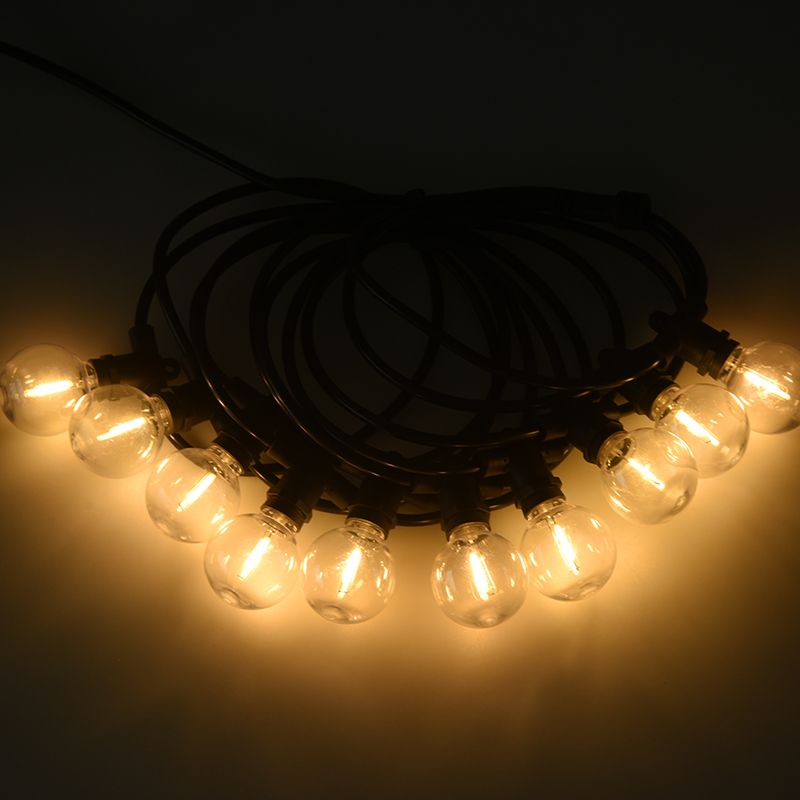 G40 integrated solar string light (E12 lamp holder, 5 meters 10 lights)The G40 integrated solar string light is an outdoor lighting product that combines illumination and decoration. It is suitable for courtyards, patios, gardens, and out...View Product →
Panel placement decides real-world performance more than battery capacity does. A panel shaded by a wall or a mature tree can drop to a fraction of its rated charge, and the string will then run for two or three hours instead of a full evening. For projects in northern Europe or in monsoon regions, buyers should plan for shorter run times in winter and either oversize the panel or add a mains-backed string for the main view line.
Where power is available, mains string lights offer more control. Low voltage 12 V or 24 V systems are popular in hospitality because they reduce electrical risk around guests and simplify compliance. Mains 110 V and 220 to 240 V systems support the full range of functions, including steady warm white, RGB synchronised colour, RGB with infrared remote control, RGBWY multicolour, and pixel-level control where each lamp can be addressed individually for chasing or meteor effects.
Hybrid layouts are the practical compromise on larger sites. Solar strings run along fences, hedging and remote garden features where cabling would be visible or expensive. Mains strings carry the focal area, such as the courtyard centre or a restaurant terrace, where consistent output through the evening matters most. The two halves should still match in colour temperature and bulb shape, otherwise the difference between them becomes obvious at dusk.
Wall-mounted areas follow the same logic. Solar wall lights in A60, G45 or vintage kerosene styles can light a facade or a boundary wall without any cable at all, and pairing them with a decorative string across the same elevation keeps the two light sources visually consistent.
Let the site choose the power source, then match colour temperature across both systems. A hybrid layout only looks intentional when the solar and mains strings share the same lamp and tone.
What Buyers Actually Weigh When They Place a Paper Lantern Light Order
Purchase decisions in this category are rarely driven by a single number. Buyers weigh weather tolerance, documentation, output consistency, customization room and packaging against each other, and the weighting shifts depending on whether the order is going to an event rental fleet, a retail shelf or a permanent hotel installation. The chart below shows an illustrative weighting drawn from typical project briefs rather than from a formal survey.
Illustrative weighting of specification criteria in a paper lantern light enquiry
Weather resistance and IP rating
Compliance and test documentation
Custom cable length and connector type
Consistency of light output and colour
Packaging and retail presentation
Weather tolerance sits at the top because it drives the failure rate a reseller inherits. A string that is sold for garden use and fails after one wet winter creates warranty cost and lost shelf space, which is why rubber-cable engineering strings are specified for exposed positions and PVC strings are kept for covered or indoor runs.
Documentation ranks almost as high, and it is often the item that decides between two suppliers with similar samples. Test reports, a Declaration of Conformity, material declarations and correct plug configurations shorten the buyer's own approval process, and for a manufacturer or brand sourcing for a retail chain that paperwork is the difference between a pilot order and a repeat programme.
Customization follows closely behind, particularly in Europe and North America where a 5 metre string rarely matches the architecture. Buyers ask for specific overall lengths, spacing between lamp holders, cable colour, plug type and controller functions, and a supplier that can prototype from a drawing or a sample keeps the project schedule intact.
Consistency of output and packaging are the quieter criteria. Colour variance between production batches is visible the moment two strings are hung side by side, and retail packaging that survives transit protects both the product and the brand printed on the box.
Weather rating and documentation carry more weight than unit price in repeat business. The cheapest string rarely survives a second winter or the buyer's own compliance review.
Customization: Voltage, Cable, Length and Packaging
Off-the-shelf strings cover a large share of paper lantern light projects, but the orders that turn into long-term programmes are usually customized. The four variables that matter most are voltage, length, cable and appearance, and they interact with each other more than buyers expect.
Voltage determines the plug, the power supply and the compliance route. A 220 to 240 V string for Europe is not interchangeable with a 110 V string for North America, and the two require different certification files. Low voltage options at 12 V or 24 V simplify safety approval and are often chosen for hospitality venues where cables run within reach of guests.
Length and spacing define whether the string fits the architecture. Buyers typically specify overall run length, lamp holder spacing, lead cable length from plug to first lamp, and whether strings connect end to end or terminate at a single plug. A common request is a 5 metre run with 10 lights at 0.5 metre centres for the standard product, then a longer 10 metre version at the same spacing for the main elevation, so the visual rhythm stays identical across the site.
Cable choice is partly technical and partly visual. Rubber compounds are specified for outdoor and cold-weather use. Black cable disappears against dark structures, white cable suits pale facades and indoor ceilings, and green cable blends into planting. On projects where cable is visible, buyers often order two colours for the same light output so the run can be routed without drawing attention to itself.
Appearance covers the parts that customers see. Lamp shape, lamp finish, cable colour, socket colour and controller housing all sit in this group. Matching a warm white lamp to ivory paper, or a clear lamp to a coloured shade, is a decision worth testing with a physical sample rather than a screen image.
Packaging closes the loop for brands and wholesalers. Retail-ready boxes with private label printing, barcodes, multilingual instructions and correct master carton labels reduce handling cost at the destination warehouse. Drop testing of the packed carton is a reasonable requirement to write into the purchase order, because a decorative string that arrives with cracked lamp housings generates returns regardless of how good the light output is.
Prototyping is the part of customization that buyers underestimate. When a supplier can develop a working sample from a drawing or a competitor sample quickly, a project can be validated before tooling or mass production begins. That step is where spacing, cable colour and connector choices get confirmed against the actual venue rather than against a catalogue photo.
Customize the four variables that change the installation: voltage, length, cable and appearance. Everything else can usually stay standard without affecting the finished look.
Where Paper Lantern Lights Work Best
Application decides the specification more than any catalogue does. The same lantern shade behaves very differently in an air-conditioned lobby and on an exposed sea-facing terrace, and the lighting system behind it should change accordingly.
- Hotel courtyards and terraces: dense spacing at 0.5 metre centres, warm white of 2200 K to 2700 K, detachable sockets for easy maintenance, rubber cable if the run is exposed.
- Restaurants, cafes and bars: lower hanging heights over tables, steady output with no flashing, dimmable or low-wattage lamps to keep the atmosphere soft.
- Wedding and event venues: a mix of paper lanterns for the ceremony look and lantern-style strings for the structural lines, with RGB or remote-controlled functions for colour changes later in the evening.
- Retail spaces and showrooms: pixel-level control or synchronised RGB for windows that change through the day, with white cable routed cleanly against pale ceilings.
- Festival and market sites: engineering-grade rubber strings on the main runs, with paper shades treated as replaceable seasonal stock.
- Residential gardens and patios: solar strings on fences, pergolas and tree branches where no outdoor socket exists, sized to the available daylight rather than to the maximum light count.
Indoor installations have their own logic, and curtain-style strings are often the better answer where lanterns would be too bulky. A seven-colour synchronised RGB curtain string can dress a window, a partition or a stage backdrop without the depth a paper lantern needs, and it packs flat for rental fleets that move between venues every week.
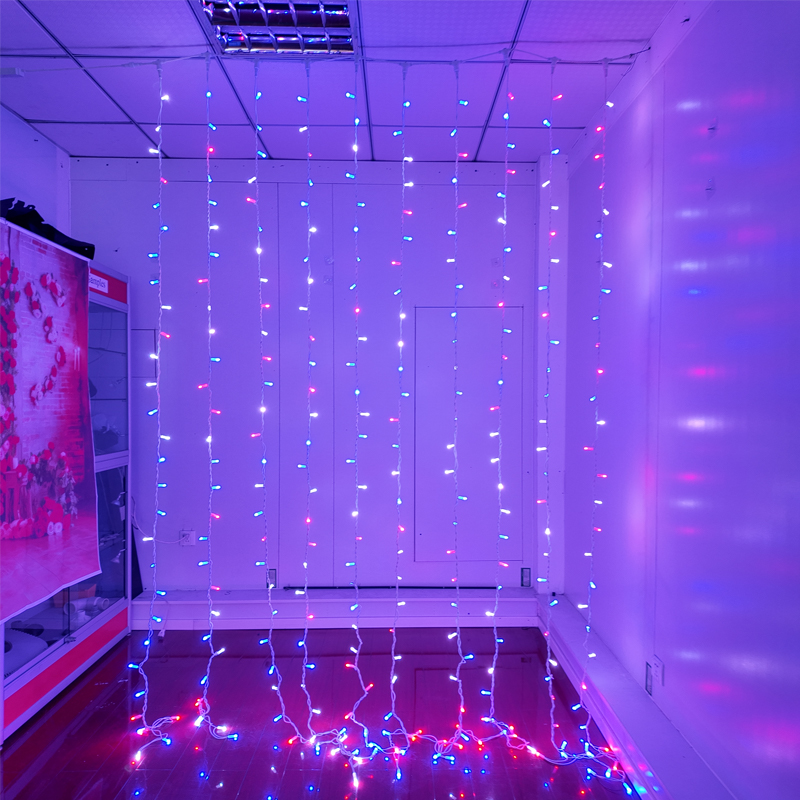 7-color synchronous RGB control curtain light stringThe "7-Color Synchronized RGB Curtain Light String" features 10 vertically hanging light strips connected in parallel to a horizontal main line, forming a curtain-styl...View Product →
In all of these settings the same rule holds: the permanent layer should be the durable layer. Paper handles the seasonal look, and hard-shell or lantern-style strings carry the year-round function. Separating those two roles keeps replacement cost predictable and stops a maintenance team from chasing paper shades through a rainy month.
Let paper handle the seasonal look and let hard-shell strings carry the permanent layer. That split keeps replacement cost predictable year after year.
Paper Lanterns, Lantern-Style String Lights or Plain Festoon?
Buyers frequently compare three options for the same wall or pergola without realizing how different their maintenance profiles are. The table below sets out the practical differences that show up after installation rather than in the showroom.
| Option | Light source | Weather tolerance | Installation effort | Lamp replacement | Best fit |
|---|---|---|---|---|---|
| Paper lantern light | E12, E26, E27 socket with 1 to 5 W LED | Indoor or sheltered positions | Moderate, each lantern is hung individually | Simple where a detachable socket is used | Events, seasonal decoration, photography |
| Lantern-style string light | Integrated E12 or E27 with metal or plastic housing | Outdoor rated, rubber cable available | Low, the run is installed as one line | Integrated or detachable depending on model | Courtyards, facades, permanent garden lighting |
| Plain festoon string | E27 or E26 with 1 to 2 W sign lamps | Outdoor rated with sealed connectors | Low, tensioned between anchor points | Standard screw-base lamps | Restaurant terraces, market lanes, long elevations |
The comparison points to a common pattern in commercial work. Paper lantern lights are bought for the way they scatter light through a translucent skin, which no hard housing reproduces exactly. Lantern-style and festoon strings are bought for the way they survive weather and repeated handling. Projects that need both usually install the hard string first, then add paper lanterns along the same support wire during the season.
There is also a cost angle that rarely appears in the initial quote. Paper shades are consumables in exposed positions; sockets, cable and controllers are the assets. A supplier who can keep the socket and cable standard while varying only the shade gives buyers a cheaper path to next season's look, because only the consumable half has to be replaced.
Treat the shade as a consumable and the socket and cable as the asset. That framing keeps both the specification and the budget under control.
Quality Control and Delivery: What to Ask Before You Commit
The questions that protect a buyer are not complicated, but they need to be asked before the purchase order is signed rather than after the first container arrives. A manufacturer with a structured quality system can answer all of them with documents rather than assurances.
- Is there inspection at incoming material, in-process assembly and finished goods, or only a final visual check?
- Is there an aging or burn-in test on finished strings, and how long does it run?
- Are IP-rated models tested for water ingress as part of routine production, not only at sample stage?
- Which test reports and declarations accompany the shipment, and are they issued for the exact model ordered?
- How is plug polarity and continuity verified, and is there a high-potential insulation test on mains products?
- What packaging validation is carried out, and can a carton drop test be included in the order specification?
- What are the sample lead time and the production lead time, and what is the policy on spare lamps and spare sockets?
- Can the supplier handle export documentation, including the commercial invoice, packing list and certificate of origin?
Delivery performance is usually the second concern after product quality, and it is easier to assess than most buyers expect. A supplier that holds a stock of standard lamp holders, cable and controllers can hold a quoted lead time across several orders instead of pushing it out each time demand rises. Buyers should also confirm how the shipment is consolidated, because a decorative lighting order often mixes long cartons, small accessory boxes and paper shades that must not be crushed under a pallet.
Export capability matters here as well. A manufacturer with independent export rights and working knowledge of international market regulations can prepare the correct documents and the correct plug configuration for each destination, which removes a step that buyers would otherwise manage themselves or pay a forwarder to handle.
Documentation on the product itself is worth checking once samples arrive. Confirm that the lamp wattage matches the socket rating, that the cable compound matches the stated outdoor use, and that the controller functions behave as described. Small mismatches at this stage become warranty claims at scale, and correcting them before mass production costs almost nothing.
Ask for documents, not assurances, and verify them against the sample in your hand. A structured quality file is the most reliable indicator of repeat-order performance.
Frequently Asked Questions About Paper Lantern Lights
Are paper lantern lights suitable for outdoor use?
They can be used outdoors in sheltered positions, such as covered terraces, porches and pergolas where rain does not land directly on the shade or the socket. For fully exposed locations, most commercial projects treat paper as a seasonal material and rely on lantern-style string lights or festoon strings with rubber cable for the year-round layer. If the paper lantern lights are meant to stay outside for more than a season, specify IP44 or higher on the electrical parts and plan to replace the shades.
What lamp base should I specify for paper lantern lights?
Small lanterns with openings under about 30 mm generally take an E12 candelabra base, which matches C7 and small G40 bulbs. Larger lanterns usually take E26 or E27, covering G45, S14, ST38 and A60 shapes. The decision should be made together with the lantern ring diameter, because a socket that physically fits can still position the lamp so deep in the frame that almost no light reaches the paper.
How many paper lantern lights do I need for a given length?
Start with the spacing rather than the length. Dense event looks use centres of 0.4 to 0.5 metres; airy architectural lines use 1.0 to 1.2 metres. A 12 metre edge at 0.5 metre centres needs 24 lanterns, which is three standard 5 metre strings of 10 lights with spares. Always order spares, because replacement availability one season later is rarely guaranteed in the exact same shade.
Can paper lantern lights run on solar power?
Yes, provided the electrical half is a solar string rather than a mains cord set. Solar strings with E12 lamp holders and five metre runs of ten lights are common for gardens, pergolas and remote courtyards where trenching a supply line is impractical. Real-world run time depends heavily on panel placement, so a panel that stays shaded for much of the day should be repositioned or paired with a mains string for the main view line.
What is the difference between paper lantern lights and lantern-style string lights?
Paper lantern lights use a translucent paper shade over a frame, so the light is diffused and the appearance changes with the paper colour and texture. Lantern-style string lights use a hard metal or plastic housing that imitates a vintage lantern or kerosene lamp, which survives weather and handling far better. Many commercial installations use both: the hard string as the permanent backbone, the paper lanterns as the seasonal layer along the same support wire.
Can a supplier customize voltage, cable length and packaging?
Voltage, length, cable type, appearance and packaging are the standard customization variables in this category. Buyers typically specify regional voltage and plug type, overall run length, lamp holder spacing, lead cable length, cable colour and retail packaging with private label printing. Prototyping from a drawing or a physical sample is the fastest way to confirm these choices before mass production begins.
What certifications should a paper lantern light supplier provide?
For Europe, expect CE marking supported by a Declaration of Conformity, together with RoHS and REACH documentation. For North America, UL or ETL listing on the luminaire and power supply is the usual requirement. Australia and New Zealand work to RCM, and Japan to PSE. Test reports should be issued for the exact model ordered, not for a similar product in the same family.
How can I reduce fire risk in indoor installations?
Use low-wattage LED lamps instead of incandescent equivalents, confirm the socket's temperature rating against the bulb's actual operating temperature, and keep a physical gap between the paper and any heat source such as a transformer or control box. Flame-retardant paper treatment slows ignition but does not replace those three practices, and daisy-chaining more strings than the rated load should always be avoided.
Most sourcing problems trace back to the electrical half, not the paper. Settle sockets, wattage, cable and documentation first, and the shade becomes a straightforward design choice.
Related Resources and Next Steps
If you are planning a paper lantern light installation, the fastest route to a workable specification is to fix four things first: the mounting height, the lantern diameter, the socket base and the power source. Everything else, from spacing to controller functions to packaging, follows from those four decisions.
For buyers who want to go deeper before requesting a quotation, the following pages are a useful starting point.
- A commercial string lights guide to uniform, waterproof outdoor lighting
- Solar string lights for off-grid courtyards and garden installations
Ningbo Hengboyi Lighting develops and manufactures string lights and solar lighting for lighting brands and manufacturers, with product lines covering solar string lights, solar wall lights, curtain string lights and decorative festoon strings in E12, E26 and E27 bases. Customization is available across voltage, length, cable type, appearance and packaging, and prototypes can be developed from drawings or samples so that a specification is confirmed before production begins.
Bring the mounting height, the lantern diameter and the power situation to the first conversation. Those three answers usually shorten the path from enquiry to a quotation that fits the site rather than the catalogue.
Related Products
-
 View More
-
 View More
G45 Hanging Type E27 Spiral RGB Synchronized Flashing String Lights
-
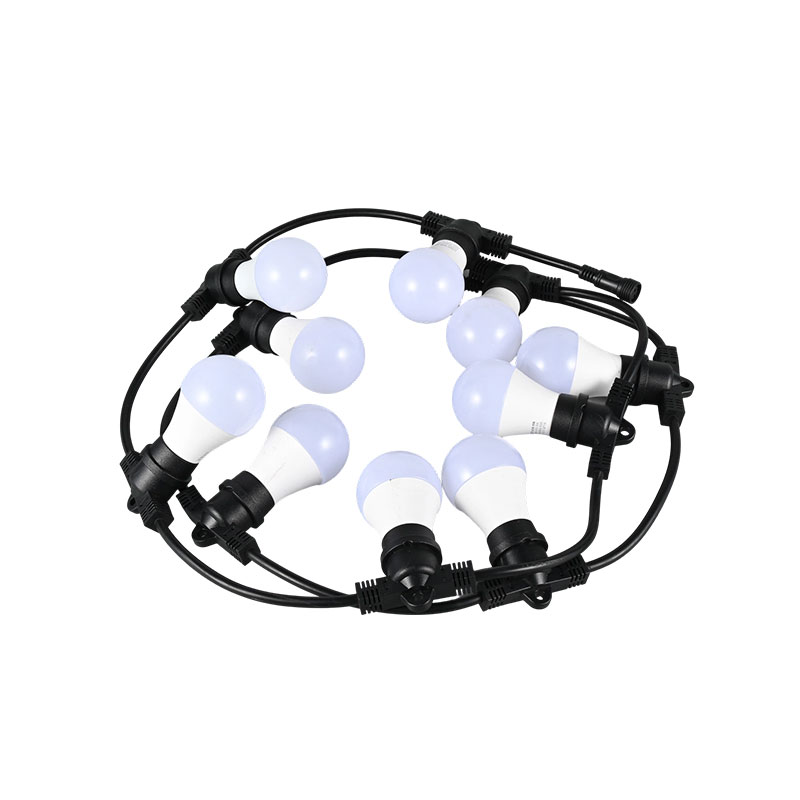 View More
E27 Spiral RGB Infrared Remote Control Energy-Saving String Lights
-
 View More
Bamboo weave G40 solar light string (5 meters 10 lights)
-
 View More
C45 Hanging Type E27 Spiral RGB Synchronized Flashing String Lights
-
 View More
Bamboo weave G40 solar light string (5 meters 10 lights)
Hengboyi are always ready to help you and answer your question if you need.
Request A Quote
Contact Info.
 Mob: +86-13901119074
 Tel: +86-574-62838966
 E-mail: sale2@hengboyi.com
 Add: No. 18 Rongchuang Road, Mingwei Village, Lizhou Street, Yuyao City, Ningbo, Zhejiang Province, China
Quick Links
Product List
QR CODE
Copyright Ningbo Hengboyi Lamp Co., Ltd. All rights reserved.
China best outdoor decorative solar lights Manufacturer
Custom decorative string lights indoor Factory

