What Defines Reliable Commercial String Lights: The Short Answer
The direct answer is this: reliable commercial string lights are defined by three factors working together, an adequate waterproof rating for the installation environment, a low voltage electrical design that reduces shock risk and simplifies long-run wiring, and durable LED bulb construction that resists vibration, moisture, and temperature swings over repeated seasonal use. A patio installation, a festival dining space, or a storefront canopy each place different demands on these three factors, so outdoor string lights chosen only for appearance without confirming voltage type and water resistance can fail well before the fixture's expected service life. Buyers sourcing from a China factory or China manufacturer therefore need to evaluate the full lighting system rather than a single spec sheet number.
This article walks through the common types of LED string lights available on the market, the electrical and structural principles behind waterproof and low voltage design, how to match a string light product to a specific commercial application, a detailed side-by-side comparison, maintenance guidance, and practical notes on sourcing from a professional string lights supplier. Several data visualizations are included to make technical comparisons easier to scan, and a FAQ section addresses the questions buyers most often ask when evaluating an OEM or ODM string lights program.
Key takeaway: waterproof rating, low voltage design, and LED bulb durability must be evaluated together, since commercial string light performance depends on the whole lighting system rather than any single specification.
Common Types of String Lights and Their Characteristics
String lights used across patios, commercial dining spaces, and outdoor retail environments are generally grouped by bulb style and by electrical configuration. Each type carries a different balance of brightness, durability, and installation flexibility, which is why a professional manufacturer typically offers a full range rather than a single universal design.
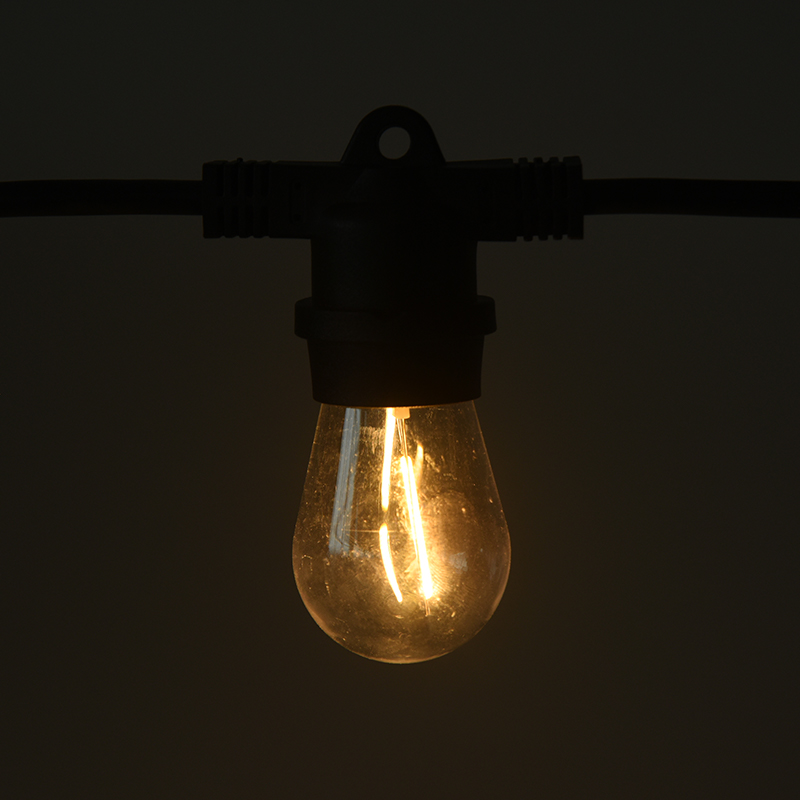
LED filament bulb string lights: use a slim filament-style LED inside a glass or shatter-resistant shell, producing a warm glow often selected for hospitality and patio string lights programs.
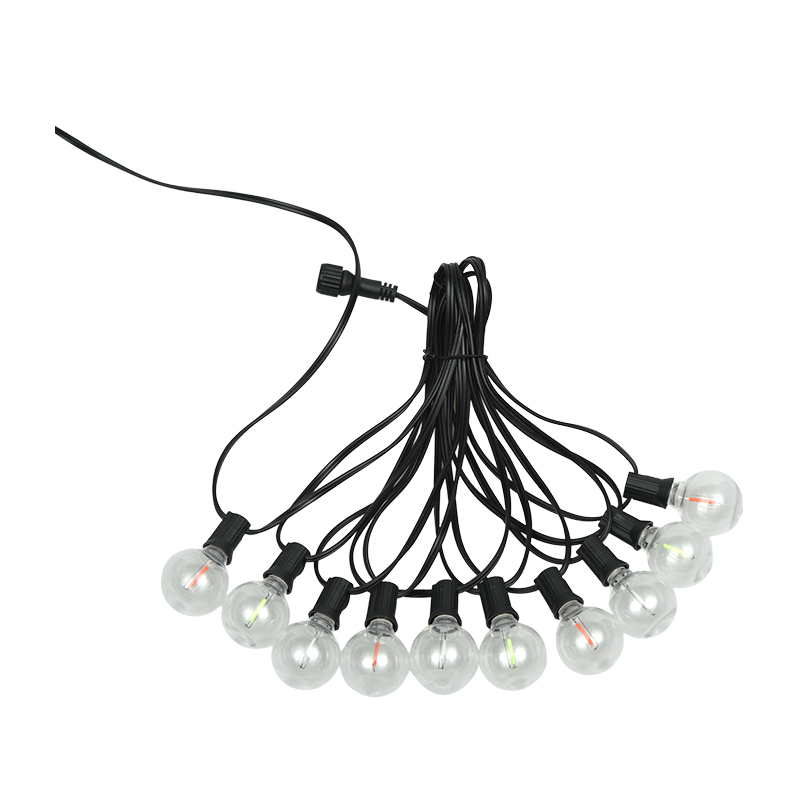
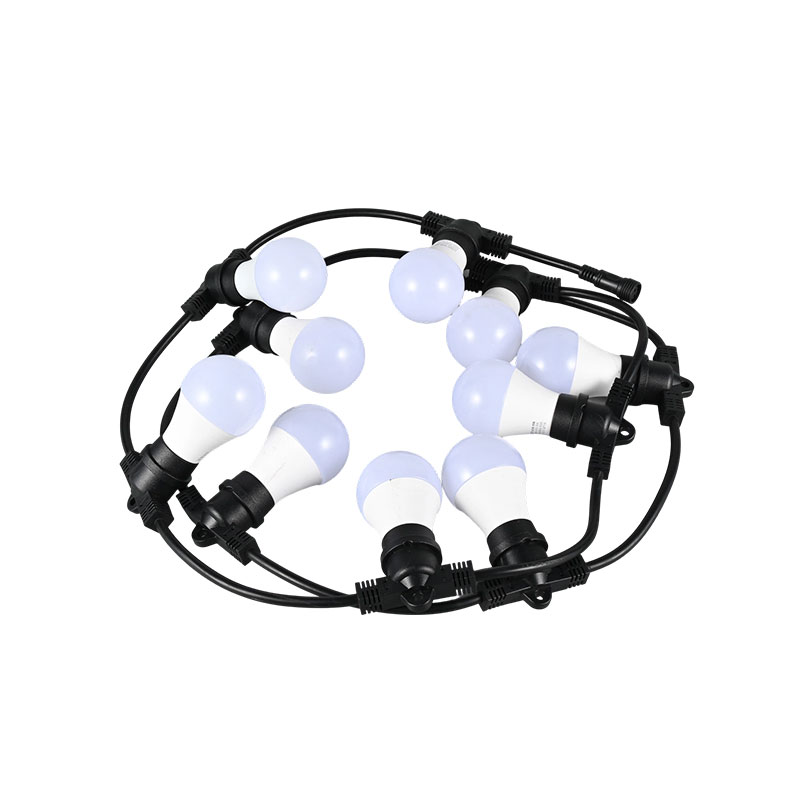
G40/globe bulb string lights: feature a rounded bulb shape widely used in festival, cafe, and event lighting where an even, decorative spacing is the priority.
Mini/fairy LED string lights: a compact, lightweight format frequently used for accent lighting, tree wrapping, and layered decorative displays.
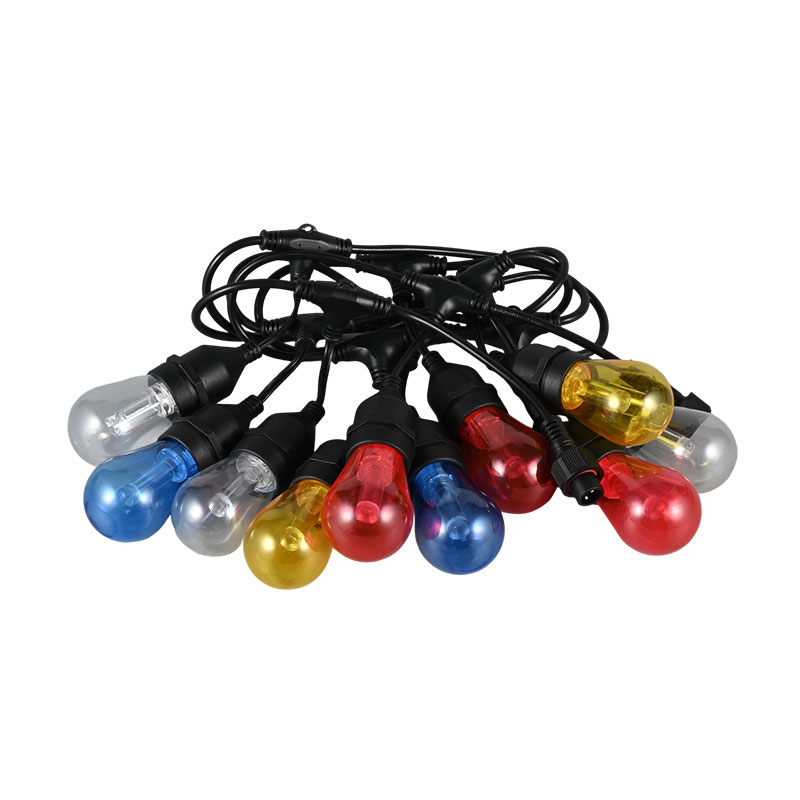
Shatterproof or shatter-resistant string lights: incorporate an impact-resistant bulb coating or plastic shell, suited to commercial spaces with higher foot traffic or wind exposure.
Low voltage string light systems: operate through a stepped-down transformer rather than standard line voltage, a configuration often preferred for long outdoor runs and multifunction installations combining several fixture lengths.
Choosing among these types is not about which is universally superior; instead, an experienced supplier will ask about installation length, climate exposure, and mounting method before recommending a bulb style and voltage configuration. A durable, adjustable string light line often blends design features from several categories, and a reliable OEM factory will be transparent about the exact wire gauge and bulb construction used in each model.
Structure and Engineering Principles Behind Waterproof, Low Voltage Design
A commercial string light is not simply a wire with bulbs attached; it is a sealed electrical system engineered to withstand outdoor exposure. Understanding this structure helps buyers evaluate whether a factory's design and testing process is capable of consistent, repeatable performance across large orders.
Waterproof Sealing at the Socket Level
Each bulb socket is typically sealed with a rubber gasket or molded compound to prevent moisture ingress at the connection point, since sockets are usually the most vulnerable part of an outdoor lighting run. A professional China manufacturer will validate that this sealing remains effective across a wide temperature range, since expansion and contraction from heat and cold can gradually loosen a poorly designed seal.
Low Voltage Transformer Design
Low voltage string light systems step down standard input voltage through a transformer before power reaches the bulb wire, which reduces the electrical load carried along the outdoor run. This approach generally allows longer continuous installations and can simplify connecting multiple string segments, since the transformer, rather than each bulb socket, manages most of the voltage reduction.
Wire Gauge and Weather-Resistant Jacketing
The copper wire gauge inside the string determines how much current the fixture can safely carry, while the outer jacketing material determines resistance to sun exposure, temperature swings, and physical abrasion. A reliable supplier will match wire gauge to the intended run length and bulb count, since undersized wire on a long commercial run can lead to uneven brightness or premature wear.
Key takeaway: socket-level waterproof sealing, transformer-based low voltage design, and appropriately sized wire and jacketing together determine whether a string light system will perform reliably through repeated outdoor seasons.
Bulb Type Composition in Commercial Outdoor Installations
Before comparing application scenarios, it helps to visualize how commercial installations are generally distributed across the main bulb styles described above. A donut chart is well suited to this kind of composition data, since it shows how each bulb type contributes to the overall installation mix without the added visual clutter of a full pie chart. The figures below reflect a general, industry-informed composition pattern for commercial and hospitality string light installations rather than a single verified market census. Buyers should treat this as a general planning reference rather than an exact market-share figure for any specific region. The chart below groups four common bulb styles so the relative share of each can be read at a glance.
LED filament bulbs make up the largest share of the mix, which reflects their popularity in hospitality and patio string lights settings where a warm, decorative glow is the primary visual goal. G40 or globe-style bulbs represent the second-largest share, consistent with their long-standing use in festival and outdoor dining environments where even bulb spacing and a classic look are valued. Mini or fairy LED string lights occupy a meaningful but smaller share, largely because they are more often used for accent or layered lighting rather than as the primary illumination source across a large commercial space. Shatterproof string lights represent the smallest share shown here, which is not a reflection of lower quality but rather a sign that they are typically specified for a narrower set of higher-traffic or higher-risk installations rather than general decorative use. Reading these four segments together suggests that most buyers currently prioritize visual warmth and even spacing over specialized impact resistance, though that balance can shift for specific venue types such as sports bars, boardwalks, or event spaces with higher foot traffic. For a wholesale supplier stocking multiple bulb types, this composition data is a useful guide for allocating inventory proportionally rather than stocking every bulb style in equal volume. Buyers developing a private label catalog can use this same composition as a starting allocation, then adjust based on their specific customer base and venue focus. The relatively small shatterproof segment also signals an opportunity for OEM programs targeting venues with elevated safety requirements, since this remains a less saturated segment of the broader string light category. Ultimately, this donut chart is best read as a snapshot of general market composition rather than a rule for how any single buyer should allocate their own product mix.
Application Scenarios and Selection Criteria
Selecting a string light product should start from the installation scenario rather than the bulb style name. The table below outlines how different applications typically map to bulb type, voltage configuration, and waterproof priority, which is useful when briefing an OEM factory or ODM factory on a new product line.
General guidance for matching string light selection to installation scenario; actual specification should be confirmed with the manufacturer.
Application
Recommended Bulb / Voltage
Typical Priority
Residential and small patio
LED filament, low voltage
Warm ambiance and simple installation
Restaurant / cafe outdoor dining
G40 globe bulb, low voltage
Even spacing and consistent decorative look
Commercial festival / large event space
Shatterproof globe bulb, waterproof rated
Durability under high foot traffic and weather exposure
Retail storefront / architectural accent
Mini/fairy LED, low voltage
Subtle accenting with flexible layout
Coastal or high-humidity venues
Waterproof LED string lights, sealed sockets
Maximum resistance to moisture and salt exposure
Beyond venue type, buyers should also confirm total run length, connector compatibility for linking multiple string segments, and whether the order requires eco friendly or dimmable, adjustable brightness options, since many wholesale supplier programs now offer these as standard alternatives alongside basic fixed-brightness models.
Key takeaway: selection should begin with the venue's exposure conditions and run-length requirements, then narrow down to bulb style and voltage configuration, rather than choosing a bulb style first and forcing it to fit the application.
Voltage Configuration Across Commercial Application Categories
Low voltage and standard line voltage systems are not evenly split across every commercial application; the balance shifts depending on installation length and venue type. A stacked bar chart is useful here because it shows how the two voltage configurations divide within each application category on a single, easy-to-compare bar. The figures below reflect general procurement patterns commonly discussed in outdoor lighting sourcing conversations rather than a single certified market study. Viewing three application categories side by side in stacked form makes it easier to see where low voltage design dominates and where standard voltage remains more common. This comparison is particularly useful for buyers deciding which voltage configuration to prioritize when developing a new product line.
The patio and residential category shows the largest share of low voltage installations, which aligns with the shorter run lengths and simpler transformer setups typical of home and small business use. The restaurant and cafe category shows a somewhat more balanced split, since these venues often combine shorter accent runs with longer perimeter lighting that may call for a mix of voltage configurations depending on layout. The large event and festival category shows the highest proportion of standard voltage installations among the three groups, which is consistent with the very long cumulative run lengths and higher power demands typical of large temporary or semi-permanent event lighting. This pattern suggests that voltage configuration decisions are closely tied to total installation length rather than venue type alone, since even a festival installation could shift toward low voltage design if broken into shorter zoned segments. For a manufacturer or exporter, this data indicates that both voltage configurations remain commercially relevant, and a well-rounded product catalog should offer both rather than standardizing on a single voltage type. Buyers developing a private label lighting program for smaller venues can reasonably prioritize low voltage low voltage string lights as a primary offering, while buyers serving event production companies may need to stock a larger share of standard voltage options. A professional wholesale supplier should be able to advise on transformer sizing and daisy-chaining limits for both configurations, since improperly matching voltage type to run length is a common cause of dimming or uneven brightness across a long installation. This chart also highlights an opportunity for OEM programs to develop clearly labeled product lines split by intended run length, which simplifies decision-making for downstream retail and installation customers. Overall, the stacked comparison reinforces that voltage configuration should be treated as a functional engineering decision tied to run length, not simply a fixed default applied across an entire product catalog.
Detailed Comparison of String Light Bulb Types and Specifications
The table below consolidates the practical specifications a buyer typically needs when comparing string light bulb types side by side, including approximate wattage per bulb, relative lifespan, and general waterproof suitability. This is intended as a working reference for briefing a China supplier or reviewing a factory's technical data sheet.
Comparative overview of common string light bulb types; exact figures vary by factory specification.
Bulb Type
Approx. Wattage
Relative Lifespan
Waterproof Suitability
LED filament bulb
0.5-1 W per bulb
High
Good with sealed socket design
G40 / globe LED bulb
0.4-0.9 W per bulb
High
Good, widely used outdoors
Mini / fairy LED bulb
0.1-0.3 W per bulb
Medium-High
Moderate, best for sheltered accents
Shatterproof globe bulb
0.4-0.9 W per bulb
High
High, suited to exposed installations
A professional OEM supplier or ODM supplier should be able to provide a technical data sheet matching this format for every model, including wire gauge, transformer rating for low voltage systems, and recommended maximum run length, since this documentation is what allows a wholesaler or brand owner to write accurate product descriptions for their own customers.
Adoption Trend of LED String Lights Over Incandescent Alternatives
Adoption of LED string lights relative to older incandescent-style string lights has not stayed flat across recent years; it has grown steadily as commercial venues prioritize energy efficiency and reduced bulb replacement frequency. An area chart is well suited to showing this kind of cumulative growth, since the shaded region emphasizes how the adoption share builds up over time rather than only showing a single line. The figures below reflect a general relative growth pattern discussed in outdoor and commercial lighting trend commentary rather than a precise figure from any single certified survey. Viewing the trend as a shaded area makes the steady, compounding nature of the shift easier to interpret than a simple year-over-year percentage. This section focuses specifically on how LED adoption has moved relative to older bulb technology across a recent multi-year period.
The shaded area beneath the line grows steadily wider from left to right, visually reinforcing that LED adoption has expanded consistently rather than in a single sudden jump. The steepest portion of the climb sits in the middle years of the chart, suggesting that this is the period when LED string lights moved from a niche upgrade to a more standard commercial default. By the final year shown, the line reaches its highest point, indicating that LED adoption share has become the clear majority configuration in the commercial and hospitality lighting segments this chart is meant to represent. This steady upward trajectory is consistent with broader energy-efficiency trends reported across commercial lighting more generally, where LED technology has progressively displaced older incandescent-style bulbs due to lower energy draw and longer bulb life. For a manufacturer or exporter, this trend supports continued investment in LED-specific production lines and technical support resources rather than treating LED as a secondary product alongside incandescent-style offerings. Buyers still holding inventory of older incandescent-style string lights may want to plan a phased transition toward LED-based catalogs given how far this adoption curve has already progressed. Wholesale distributors positioning a catalog for long-term relevance should treat LED string lights as the primary growth category, with incandescent-style products positioned as a smaller legacy or nostalgia-oriented niche. This trend also has implications for after-sales support, since LED string lights generally require less frequent bulb replacement service than older technology, which can shift a supplier's post-sale service model over time. For OEM and ODM brand owners, aligning new product launches with this adoption curve means prioritizing LED-based designs, including waterproof LED string lights, as the primary offering for new commercial and hospitality lighting programs. Overall, the area chart reinforces that LED adoption is a sustained, compounding shift rather than a short-term trend, which should inform long-range production and inventory planning.
Relative Energy Efficiency of LED String Lights vs Incandescent-Style Alternatives
Energy efficiency is one of the most frequently cited reasons commercial venues shift toward LED string lights, and a gauge chart is a useful way to visualize how far LED technology has progressed on this single measure relative to older incandescent-style bulbs. This section presents a simplified efficiency gauge intended for general orientation rather than a precise engineering measurement of any single product. The gauge reflects commonly cited relative efficiency positioning for LED lighting technology in general commercial use. Because a gauge shows a single indicator moving toward a maximum point, it is an intuitive way to summarize a complex efficiency comparison in one visual. The following gauge focuses specifically on relative energy efficiency rather than brightness, lifespan, or cost factors covered elsewhere in this article.
The gauge needle sits well into the upper portion of the scale, reflecting the generally accepted position that LED bulbs convert a substantially higher share of input electricity into visible light compared with older incandescent-style bulbs, which lose more energy as heat. This efficiency advantage is one of the central reasons commercial venues with long string light runs and extended nightly operating hours have shifted toward LED technology, since even a modest per-bulb efficiency gain compounds significantly across hundreds of bulbs run for many hours each night. The needle position here should be read as a general efficiency orientation rather than a precise percentage figure, since exact efficiency varies by specific bulb design, driver circuitry, and manufacturing quality. For venues operating string lights nightly across an entire season, this efficiency gap also tends to translate into less frequent bulb replacement, since LED bulbs generally run cooler and experience less thermal stress than incandescent-style filaments. A professional China supplier developing new string light products should treat energy efficiency as a headline technical differentiator when positioning LED-based lines to commercial and hospitality buyers. Buyers evaluating multiple supplier quotes can reasonably use relative efficiency, alongside waterproof rating and wire gauge, as one of the core criteria for comparing otherwise similar-looking string light products. This gauge also reinforces why many eco friendly outdoor lighting programs default to LED technology, since energy efficiency is one of the more direct and easily communicated sustainability benefits available in this product category. For OEM and ODM brand owners building a marketing narrative around their string light catalog, energy efficiency data of this kind can support a factual, non-exaggerated case for LED adoption without relying on absolute or guarantee-style claims. Overall, the gauge chart makes clear that LED string lights occupy a strong relative position on energy efficiency, which is a central factor supporting their continued adoption across commercial outdoor lighting programs.
Maintenance Guidelines for Outdoor String Light Installations
Routine maintenance significantly extends the reliable service life of any string light installation, regardless of bulb type. Following a few consistent habits helps preserve waterproof performance, even illumination, and safe electrical operation over repeated seasonal use.
Inspect socket seals periodically for cracking or gaps, since a compromised seal is one of the most common causes of moisture-related failure in outdoor installations.
Check connector points where multiple string segments join together, ensuring they remain firmly seated and free of corrosion.
Confirm that low voltage transformers remain protected from standing water and are mounted in a location with adequate airflow.
Clean bulbs and wire runs of dust and debris periodically, since accumulated buildup can trap moisture against the fixture surface.
Store string lights in a dry, protected location during extended off-season periods to reduce cumulative exposure to temperature swings.
Key takeaway: routine seal inspection, secure connector checks, and protected transformer placement are the habits that most reliably maintain a string light system's waterproof performance across multiple seasons.
Working with a Reliable String Lights Manufacturer for OEM and ODM Orders
For brand owners and wholesalers, the sourcing relationship matters as much as the technical specification itself. A capable China manufacturer should be able to support both OEM manufacturing (producing to a customer's existing design) and ODM manufacturing (co-developing a design from a customer's general requirements), and should be transparent about production capacity, component sourcing, and quality inspection procedures at every stage.
Ningbo Hengboyi Lamp Co., Ltd. is one example of this kind of manufacturing enterprise in practice. Formerly known as Yuyao Hengli Auto Parts Factory and established in 2003, the company is based in Yuyao City, Zhejiang Province, an area recognized within China for its plastics manufacturing base, and operates as an OEM commercial outdoor lighting supplier and ODM decorative outdoor commercial lighting factory. The company integrates research and development, production, sales, and self-operated export under one structure, with a primary focus on precision plastic product processing and high-tech electronic products. Its main business scope spans lighting fixtures and lighting accessories alongside electronic products, injection molded parts, rubber parts, and hardware parts, which supports a degree of in-house component control relevant to string light production such as sealed sockets and molded connector housings. The company maintains complete processing, production, and testing equipment along with a structured management system, and has built experience over time in the manufacturing and design of lighting fixtures and accessories, with product appearance and quality noted by both domestic and international customers who have developed long-term cooperative relationships with the company. Since its establishment, the company has followed a stated philosophy of quality first, integrity foremost, scientific management, and pragmatic innovation in its approach to customer relationships. For wholesale supplier partners and OEM/ODM brand owners, working directly with a manufacturer that also produces its own injection molded and electronic components can simplify communication around custom string light design, connector compatibility, and quality consistency compared with sourcing through multiple disconnected intermediaries.
When evaluating any potential China supplier or China producer for a string lights program, buyers generally benefit from asking about in-house injection molding and electronic assembly capacity, minimum order flexibility for custom voltage configurations, and whether eco friendly or dimmable, adjustable brightness options are available alongside standard fixed-output lines. A transparent factory will walk through each of these points without hesitation, which is itself a useful signal of overall production professionalism.
Frequently Asked Questions About String Lights Sourcing
Q1: What makes a string light suitable for outdoor patio use?
Suitable patio string lights generally combine a sealed, waterproof socket design with LED bulbs and appropriate wire jacketing, so the fixture can handle rain, humidity, and temperature changes across seasons.
Q2: Can a factory produce string lights with a custom voltage configuration?
Most professional OEM and ODM factories can adjust transformer sizing and wire gauge to support a custom low voltage or standard voltage configuration, provided the request fits their existing production equipment.
Q3: How do I know if a string lights supplier can support large wholesale volumes?
Ask about in-house injection molding and electronic assembly capacity, and how bulb and socket consistency is monitored across a production batch, since these details indicate whether a supplier can scale reliably.
Q4: Are eco friendly or adjustable brightness string light options available from most manufacturers?
Many manufacturers now offer dimmable, adjustable brightness LED string lights alongside standard fixed-output models, and it is worth asking specifically since this is not always listed as a default option.
 Telephone: +86-574-62838966
 E-mail : sale2@hengboyi.com

 en
en  English
 Español
 中文简体
中文简体
 View More
 View More
 View More
 View More
 View More
 View More
 Mob: +86-13901119074
 Tel: +86-574-62838966
 E-mail: sale2@hengboyi.com
 Add: No. 18 Rongchuang Road, Mingwei Village, Lizhou Street, Yuyao City, Ningbo, Zhejiang Province, China
