 Telephone: +86-574-62838966
 E-mail : sale2@hengboyi.com


 en
 English
 Español
 中文简体

Mood Lighting Guide: Solar String Lights, Wholesale Supplier Selection
Content
- 1 What Mood Lighting Actually Is — and What It Is Not
- 2 The Five Parameters That Decide Whether Mood Lighting Works
- 3 Common Types of Mood Lighting Products and Where Each One Fits
- 4 How a Mood Lighting Fixture Is Built: Structure and Working Principle
- 5 Bulb Shapes, Bases and Output: A Practical Comparison
- 6 Power Draw and Light Output Across Common Mood Lighting Bulbs
- 7 Application Scenarios and Selection Points
- 8 How to Evaluate a Mood Lighting Manufacturer or Wholesale Supplier
- 9 Maintenance and Troubleshooting for Outdoor Mood Lighting
- 10 Common Mistakes in Mood Lighting Projects
- 11 FAQ About Mood Lighting
- 11.1 What is the difference between mood lighting and general lighting?
- 11.2 What colour temperature is best for mood lighting?
- 11.3 Can solar string lights run all night?
- 11.4 How many lamps per metre should mood lighting have?
- 11.5 What IP rating does outdoor mood lighting need?
- 11.6 Can mood lighting be customised for a specific project?
- 11.7 How do I make sure a repeat order matches the original?
A terrace project in Rotterdam ordered 600 metres of warm-white festoon on a single specification and received it in two shipments. The first batch measured 2700K. The second measured 3000K. Under daylight the two strings were indistinguishable, but at night, hung side by side over the same bar, the terrace looked cheap — not too dim, just inconsistent. By the time anyone noticed, the lighting had already been installed, and the cost of correcting it ran to roughly three times the cost of the fixtures themselves.
That failure mode is what mood lighting procurement is really about. Mood lighting is the deliberate use of colour temperature, illumination level, distribution and colour rendering to produce a specific atmosphere — a feeling in a space rather than a task performed in it. It includes ambient, accent and task layers, but in commercial work it is much easier to break than to design.
What follows is a practical tour of the subject: which parameters actually determine whether mood lighting works, how common bulb shapes and lamp bases compare, where solar and mains-powered systems each belong, and what to check before you place an order with a manufacturer, supplier or wholesaler.
What Mood Lighting Actually Is — and What It Is Not
Mood lighting is the use of specific colours or brightness levels in ambient illumination with the intention of promoting a particular, temporary state of mind. That is a functional definition, and it is stricter than the one most people carry around in their heads. If a fixture exists so that you can read a menu, it is task lighting, regardless of how warm it looks. If it changes how a room feels, it is mood lighting, even if it also happens to provide some general illumination.
Lighting designers normally think in three layers, and the distinction matters when you are writing a specification:
- Ambient light provides the overall glow and keeps the space navigable and safe.
- Accent light creates focus — a wall wash, a picture light, a highlighted tree or sign.
- Task light supports a specific activity at a specific place, such as a counter, a reading chair or a prep station.
In commercial projects the layers are what make mood lighting work. A restaurant that drops its ambient level very low and stops there will empty out; the same ambient level with a warm focal pool of light on each table will hold guests for hours. The fixtures have barely changed. The distribution has.
Two misconceptions are worth clearing up before anything else:
- Mood lighting does not have to be dim. A 4000K fixture run at low output can be mood lighting; a restaurant at 500 lux of well-distributed 2700K can be too.
- Mood lighting does not have to be coloured. RGB has its uses — events, seasonal terraces, photographic sets — but for permanent installations, choosing correctly between 2700K, 3000K and 3500K matters more than adding an RGB channel, and it is harder to get right.
In purchasing terms, that means mood lighting is a tighter specification than the catalogues suggest. Colour temperature must be defined with a tolerance, colour rendering needs a floor, and the dimming range has to be stated rather than assumed.
Mood lighting is a colour temperature and distribution problem first and a design problem second — pin down CCT tolerance, colour rendering and dimming range before you send an RFQ.
The Five Parameters That Decide Whether Mood Lighting Works
Almost every disappointing installation traces back to one of five numbers. None of them is exotic, and all of them can be written into a purchase specification.
2700K, 3000K, 3500K and 4000K are the working steps. For mood lighting, the dividing line between cosy and clinical sits between 2700K and 3000K, and the eye can detect that 300K shift reliably when two sources are in the same field of view. Define the target in terms of a MacAdam ellipse step — 3-step or better — and state a tolerance of plus or minus 150K. The tolerance is the part that people forget, and it is the part that causes the Rotterdam problem.
2. Colour rendering, and especially R9
CRI 80 is an acceptable floor for decorative string lighting. Where food, textiles or skin tones are in the lit field, aim for CRI 90 or above. R9, the deep red channel, is what most budget LEDs sacrifice first; it is the reason skin looks grey and timber looks dead, and it is rarely mentioned on a spec sheet unless you ask.
3. Illumination level and uniformity
Low is not automatically right. A restaurant table at 50 to 100 lux feels intimate; a terrace walkway needs 20 to 50 lux for safe movement; a work surface used as an accent still needs 300 lux or more. Uniformity matters as much as the absolute figure. In string lighting, the spacing between lamps determines whether you read a continuous ribbon of light or a scatter of separate points, and spacing has more influence on that perception than the wattage of any single lamp.
4. Beam angle, diffusion and glare control
A bare LED emitter at eye level is unpleasant no matter how good the colour is. Frosted globes, milk-white diffusers and lensed covers convert a point source into something the eye can rest on. Festoon is usually hung between 2.2 and 2.6 metres; drop it lower and the output has to come down, or the glare becomes the dominant impression.
5. Control method and dimming range
A dimmer that will not go below 20 percent is not a mood dimmer. Look for smooth operation down to 10 percent, and ideally 1 percent, with no flicker, no colour shift and no audible buzz. If the project uses RGB or RGBW, ask whether dimming is PWM or analogue and whether the driver still behaves at 1 percent. Infrared remote control is inexpensive but needs line of sight; radio and app control do not, and for anything installed above head height that difference matters.
Five numbers — CCT with tolerance, CRI with R9, lux level, spacing and dimming floor — determine almost every mood lighting outcome. Specify all five or accept whatever arrives.
Common Types of Mood Lighting Products and Where Each One Fits
The product families used for mood lighting are not interchangeable. Each has a structural logic that suits certain sites and rules out others.
String lights and festoon
String lights, or festoon, are the workhorse of outdoor mood lighting. A base cable carries lamp holders at fixed intervals and accepts E12, E26 or E27 screw-base lamps. G40, G45, S14, C7 and ST38 are the shapes that dominate. Lamps per metre is the governing specification: 2 to 4 per metre is typical for a terrace at eye level, dropping to around 1.5 per metre for higher runs where a softer, more scattered effect is wanted.
Lamp base standard is not a detail. E12 is the candelabra size and takes the smallest G40 and C7 shapes. E26 and E27 are the standard sizes used for S14 and G45. The two larger bases are broadly compatible in thread, but E26 is dimensioned around North American 120V practice and E27 around European 220–240V practice, so voltage, cable, plug and certification all have to travel together.
Solar string lights
Solar string lights use a small photovoltaic panel to charge a battery that then drives the string. Solar is genuinely useful here rather than a gimmick: on terraces with no mains feed, in gardens where trenching would destroy planting, and on temporary sites where running cable is expensive or impossible, it is frequently the only practical option. The trade-off is that output depends on panel area, battery capacity and controller efficiency, and all three are under cost pressure.
An integrated layout, where lamp, panel and battery sit on one cable run, reduces the number of separate components and therefore the number of failure points. A typical 5-metre, 10-lamp G40 configuration on an E12 holder is a sensible entry point for decorative use; longer runs or higher output require a larger panel and a larger cell rather than simply more lamps.
 G40 pendant type solar string light (E12 lamp holder, 5 meters 10 lights)The G40 pendant-type solar string light is an outdoor lighting product that combines illumination and decoration. It features a pendant design for flexible installatio...View Product →
Where a harder-wearing look is wanted, rubber-jacketed and heavy-gauge constructions are available in the same electrical format, and they tolerate repeated handling far better than thin PVC equivalents.
Solar wall lights
Solar wall lights mount on facades, fences and garden walls. A60 and G45 bulb shapes are common, usually behind a diffusing cover to soften the output. The design constraint here is orientation: the panel needs reasonable incidence through the day, or the product will underperform regardless of how good the battery is. Flame-effect and kerosene-lamp styling is popular in hospitality and guesthouse projects, where the goal is atmosphere rather than illuminance.
 Vintage kerosene lamp style solar wall light (flame effect)Vintage kerosene lamp solar wall light focuses on classic styling and wall-mounted ambient lighting. It features a kerosene lamp appearance combined with a flame light...View Product →
Curtain lights
Curtain string lights hang in vertical drops across glazing, partitions and outdoor frames. Synchronised RGB control allows colour gradients across a plane rather than along a line, which is why they suit winter gardens, photographic sets and bar terraces where the surface itself is the feature.
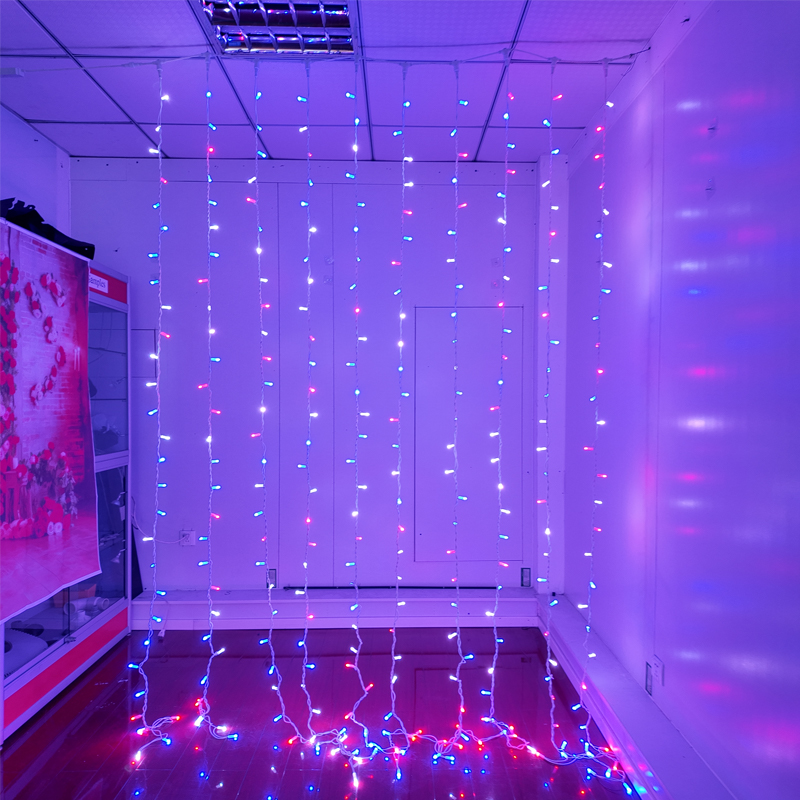 7-color synchronous RGB control curtain light stringThe "7-Color Synchronized RGB Curtain Light String" features 10 vertically hanging light strips connected in parallel to a horizontal main line, forming a curtain-styl...View Product →
Engineering and rubber string lights
Rubber-sheathed engineering string lights are specified for outdoor construction sites, festival markets and temporary structures that are erected and struck repeatedly. Rubber stays flexible at low temperature whereas ordinary PVC stiffens and cracks, so winter events and northern-latitude projects tend to call for it. These products are generally supplied between IP44 and IP65 depending on connector design, and the connector is usually the weakest point rather than the lamp.
Match the product family to the site rather than to the look: festoon for cabled terraces, solar for unpowered outdoor space, curtain lights for planes and glazing, rubber engineering string for repeated handling in cold weather.
How a Mood Lighting Fixture Is Built: Structure and Working Principle
Understanding the internal structure makes it much easier to ask manufacturers the right questions and to judge the answers.
LED light source and optical diffusion
A 1W LED emitter has a light-emitting area of a few square millimetres. Everything that makes it visually pleasant happens in the optics around it: frosted or opal polycarbonate covers, internal lenses, sandblasted surfaces. The same chip behind different diffusers can differ by 15 to 25 percent in delivered output, which is why two fixtures rated at the same nominal lumen figure can look entirely different on the same terrace.
Driver, voltage and control
String lighting is either mains-fed or low-voltage. Low-voltage systems commonly run at 12V or 24V and require an external adaptor or transformer; mains systems run at 120V or 220–240V and connect directly to a lighting circuit. Low voltage is safer and easier to route through planting or timber, and it is generally the better choice where the cable will be buried or handled. Dimming almost always happens on the driver or controller side rather than in the lamp, so if dimming matters, say so at the enquiry stage rather than after the order is confirmed.
Solar module, battery and controller
A solar string light is a miniature off-grid system: panel, charge controller, cell and a boost or LED driver. Each stage loses energy. As a rough field reference, a 1W panel with a 1200mAh cell will drive around ten low-power LEDs for four to six hours. If a supplier claims ten hours, ask at what output that figure was measured — long runtimes are frequently quoted at a fraction of the rated light output.
Housing, cable and ingress protection
The IP rating describes dust and water resistance, but it says nothing about long-term reliability in ultraviolet light or temperature cycling. A rubber cable rated IP44 will often outlast a cheap PVC cable rated IP65, because the failure mechanism in real installations is jacket embrittlement and connector corrosion rather than immersion. Ask what the jacket material is and how the connectors are sealed, not only what number appears on the label.
The optical diffuser, the driver and the cable jacket decide real-world performance far more than the LED chip specification does.
Bulb Shapes, Bases and Output: A Practical Comparison
When you are assembling a mood lighting package, the lamp shape is usually chosen first and the electrical details follow. The table below sets out the common shapes side by side so that the trade-offs are visible at a glance.
| Lamp shape | Base | Typical power | Typical output | Character and typical use |
|---|---|---|---|---|
| C7 (strawberry / candle) | E12 | 0.5–1 W | 20–40 lm | Small, distinctly point-like; wreaths, signage, tight decorative runs |
| G40 (globe) | E12 | 0.8–1 W | 40–60 lm | The classic festoon look; gardens and terraces |
| ST38 (vintage tube) | E12 | 1 W | 40–50 lm | Slim retro silhouette; porches, pathways, low-glare runs |
| S14 | E27 / E26 | 0.8–1.5 W | 70–100 lm | Warm-white retro bulb; the default for bars and restaurant terraces |
| G45 (globe) | E27 | 1–2 W | 80–130 lm | Larger, fuller globe; hospitality terraces at height |
| A60 | E27 | 3–5 W | 250–400 lm | Substantial output; wall lights and semi-functional ambient use |
Two patterns are worth drawing out. First, the decorative shapes — C7, G40, ST38, S14 — cluster tightly between roughly 40 and 100 lumens, so choosing between them is mainly a styling decision rather than an output decision. Second, moving up to G45 or A60 multiplies output several times over, which is what makes those shapes useful where the lighting also has to do some functional work.
Decorative lamp shapes are interchangeable in output terms — pick them for silhouette. Choose G45 or A60 only when the installation must also deliver usable illuminance.
Power Draw and Light Output Across Common Mood Lighting Bulbs
Wattage is the number buyers ask about first and the number that matters least. A lamp drawing 1W tells you about running cost and driver sizing; it tells you almost nothing about how the installation will look.
Light output, measured in lumens, is what the eye actually responds to, and the relationship between the two is not linear across lamp shapes.
Decorative globes and candle shapes cluster in a narrow band of low output, while larger shapes jump well beyond it.
The gap between the lowest and highest shape is roughly ten to one, which is why mixing families on a single cable run is almost always a mistake.
The chart below is a schematic comparison rather than a measured dataset; treat it as a way to reason about relative magnitude when you are assembling a lighting package.
A60 · 4 W~320 lm
G45 · 1.5 W~110 lm
S14 · 1 W~85 lm
G40 · 1 W~50 lm
ST38 · 1 W~45 lm
C7 · 0.6 W~25 lm
The first thing the chart shows is how compressed the decorative group is. G40, ST38 and S14 all sit within roughly a factor of two of one another, and C7 sits only slightly below them. That means a designer choosing between those four shapes is effectively choosing a silhouette and a diffusion characteristic, not a brightness level. The consequence for procurement is straightforward: you can substitute one decorative shape for another late in a project without materially changing the lighting level, but you cannot substitute an A60 for a G40 without redesigning the scene.
The second observation is the size of the jump to A60. At around 320 lumens from roughly 4 watts, a single A60 delivers more light than six G40 lamps combined. That is a different category of product disguised as the same category on a catalogue page. If a quotation mixes A60 wall lights and G40 string lights under one heading of mood lighting, the two halves of the installation will read as belonging to different projects unless the A60s are run at low output or covered by a heavy diffuser.
Third, the wattage spread is far narrower than the lumen spread. Every lamp in the chart except the A60 draws between 0.6W and 1.5W. A 60-lamp run of S14 therefore consumes around 60W including driver losses, which is trivial for a mains circuit but is a serious load for a solar system. This is where buyers most often make an arithmetic error: they size the solar panel on the lamp count and discover too late that the controller, the cell and the inverter losses push the real draw well above the estimate.
Fourth, the lumen figures are nominal. Output falls with colour temperature spread, with diffuser opacity and with drive current. A frosted cover over a G40 will typically cost 15 to 25 percent of the bare output, and running a lamp below its rated current to extend battery life in a solar system reduces output proportionally. When comparing quotations, ask whether the stated lumen figure is for the bare emitter or the finished, assembled fixture. The two numbers can differ by a third, and suppliers are not always consistent about which one they publish.
Fifth, the chart explains why spacing rather than wattage governs perceived brightness in festoon. Because the decorative shapes are so close in output, the variable that changes how a run of lamps reads is how far apart they sit. Reducing spacing from 0.5 metres to 0.33 metres adds 50 percent more sources without changing any individual lamp specification, and it produces a more continuous ribbon of light than upgrading every lamp ever would.
Decorative lamp shapes differ by less than a factor of two in output — spend the budget on tighter spacing and better diffusion rather than on higher wattage lamps.
Application Scenarios and Selection Points
Different sites impose different constraints, and the same product family behaves differently depending on where it is installed.
Courtyards and gardens
Gardens are where spacing and cable routing matter most. Because the run is long, voltage drop along a low-voltage cable becomes visible as dimming toward the far end. Keep low-voltage cable runs short, or split the installation into several independently fed circuits. Solar products suit garden beds where no power exists; a 5-metre, 10-lamp unit is typically adequate for a single seating zone, and larger installations are better served by several smaller units than by one long string.
Building exteriors and walls
Wall-mounted mood lighting is judged at close range and at an upward angle, so glare control and colour consistency between adjacent units dominate. Mounting height and panel orientation for solar models should be decided on site before ordering; a wall light installed where the panel sees only two hours of direct light will underperform regardless of the electronics.
Curtains and interiors
Interior mood lighting has to contend with reflectivity. Curtain drops against glazing produce strong reflections at night, and control systems with visible colour stepping become obvious on a flat plane. Ask for smooth fades between colour states rather than discrete steps if the surface is large.
Festivals and events
Temporary installations are cycled on and off far more often than permanent ones and are handled by crews who have no reason to be gentle. Rubber jackets, sealed connectors and detachable lamps are worth the premium. Specify spare lamps as a line item at order rather than trying to source a matching CCT later.
Off-grid and solar projects
For remote sites, size the system on measured consumption rather than on lamp count. Work out lamp watts multiplied by hours, add roughly 25 percent for controller and conversion losses, then size the panel for a realistic daily charging window — not a best-case one. Local winter weather is what determines whether the installation still works in January.
Size solar mood lighting from measured watt-hours plus losses, never from lamp count alone — the panel, not the string, is what fails in winter.
How to Evaluate a Mood Lighting Manufacturer or Wholesale Supplier
Once the specification is settled, the risk moves to the supply side. These are the areas where problems actually surface, in roughly the order they appear.
Ask specification questions before requesting a catalogue
A supplier who can answer questions about CCT tolerance, diffuser material, R9 values and dimming floors without going away to check is a supplier who understands the product. One who replies only with pictures is a trading operation, which may be perfectly fine, but you should know which you are dealing with.
Manufacturing capability and process control
Ask how incoming LED batches are binned and whether wafers from different bins are mixed within a single order. Batch mixing is the single most common cause of colour variation across a long run of string lights, and it is entirely preventable at the factory.
Certification and export documentation
For cross-border projects, confirm which safety and electromagnetic compliance standards apply in the destination market, and ask for the test reports rather than a certificate summary page. A supplier with independent export qualification and experience of destination-market regulations will usually have the file ready.
Customisation capability
Voltage, cable length, wire gauge, lamp spacing, finish and packaging are all legitimate points of customisation in this category. The relevant question is how quickly a prototype can be produced from drawings or a sample, because that turnaround is what determines whether a project can be revised without slipping its schedule.
Consistency, packaging and logistics
Ask how a repeat order is matched to the original. Good practice is to retain a sealed reference sample and to verify against it, and to record the LED bin and diffuser batch on the order confirmation. Packaging matters more than it seems: festoon arrives on reels or in coils, and a coil that has been wound under tension will kink and misbehave on site.
Further reading from our factory floor
If you want background on how these products are built and how they are specified for commercial use, start with the manufacturer profile at Ningbo Hengboyi Lighting and the practical overview in our commercial outdoor and indoor decorative lighting guide.
The single most useful question to ask a mood lighting supplier is how they prevent LED bin mixing between batches — the answer tells you almost everything about their process control.
Maintenance and Troubleshooting for Outdoor Mood Lighting
Outdoor mood lighting fails in predictable ways, and most of them can be headed off with a maintenance routine that takes a few hours a year.
- Inspect connectors at the start and end of each season. Corrosion at the joint, not failure of the lamp, causes most intermittent faults.
- Clean solar panels quarterly. A film of dust and pollen can reduce charging enough to shorten nightly runtime noticeably by mid-winter.
- Expect reduced battery capacity in cold weather. Lithium cells lose usable capacity below roughly 5 degrees Celsius, so a system that runs eight hours in summer may run four in January. That is normal behaviour, not a defect.
- Replace lamps in matched sets. Swapping one lamp from a different production batch will usually be visible at night even if the colour temperature is nominally identical.
- Check cable tension after storms. Festoon hung with slack collects water in low points and stresses the connectors.
- Store spare lamps in the original packaging and out of direct sunlight; UV exposure degrades the diffuser material even when the lamp is not in use.
For fault-finding, work from the supply end backwards. Confirm the driver or solar controller output first, then test a known-good lamp in the suspect holder, then inspect the cable. In practice, roughly half of reported lamp failures turn out to be holder or connector problems.
Store a sealed reference sample from every order — it is the only reliable way to match a replacement batch to the original installation.
Common Mistakes in Mood Lighting Projects
The same handful of errors shows up across projects in different countries and different market segments.
- Specifying colour temperature without a tolerance, then accepting whatever arrives.
- Mixing lamp shapes on one cable run and expecting the result to look intentional.
- Sizing a solar system on lamp count rather than measured watt-hours.
- Choosing a dimming system that will not go below 20 percent, which removes most of the mood range.
- Ignoring R9 and then wondering why food and skin tones look wrong under otherwise warm light.
- Buying on lumens per unit cost without comparing finished, diffused output.
- Leaving spare lamps and spare connectors out of the original order.
- Assuming an IP rating alone guarantees long-term durability in UV and freeze-thaw conditions.
Most mood lighting failures are specification failures, not product failures — and they are cheaper to prevent at the RFQ stage than to correct after installation.
FAQ About Mood Lighting
What is the difference between mood lighting and general lighting?
General lighting is judged by whether people can see and move safely. Mood lighting is judged by how the space feels. In practice the two overlap, but the specification priorities differ: general lighting is driven by lux levels and uniformity, while mood lighting is driven by colour temperature, distribution and glare control at the viewing position.
What colour temperature is best for mood lighting?
Between 2700K and 3000K covers most hospitality, residential and garden applications. Move toward 3500K only where the environment is already warm-toned or where some functional reading is expected. Whatever you choose, define it with a tolerance such as plus or minus 150K, because consistency across a long run matters more than the exact target.
Can solar string lights run all night?
It depends on panel size, battery capacity and the output level at which runtime is quoted. A small decorative unit may realistically deliver four to six hours of useful light in winter and longer in summer. If a supplier claims ten or more hours, ask at what brightness the figure was measured and under what seasonal conditions.
How many lamps per metre should mood lighting have?
For terrace and garden festoon hung at 2.2 to 2.6 metres, 2 to 4 lamps per metre gives a continuous ribbon of light. For higher or more scattered effects, 1.5 lamps per metre is often enough. Spacing affects perceived brightness more than the wattage of individual lamps, so treat it as a primary specification rather than an afterthought.
What IP rating does outdoor mood lighting need?
IP44 is adequate for sheltered terraces and covered pergolas. IP65 is appropriate where the installation is fully exposed to driving rain or where it will be washed down. Remember that the connector is usually the weakest point, so ask how the joints are sealed rather than relying on the headline rating.
Can mood lighting be customised for a specific project?
Yes, and this is normal in the category. Voltage, cable length, wire gauge, lamp spacing, finish and packaging are all routinely customised, and a prototype can usually be produced from drawings or a supplied sample. Confirm the prototyping lead time early, because that is what determines how much revision is possible within a project schedule.
How do I make sure a repeat order matches the original?
Keep a sealed reference sample from the first delivery, record the LED bin and diffuser batch on the order confirmation, and verify the new batch against the sample before it ships. Colour variation between production runs is the most common complaint in this product category and the easiest to prevent.
Write colour temperature tolerance, lamps per metre, IP rating and dimming floor into the purchase order — those four lines prevent most mood lighting disputes.
Mood lighting rewards precision more than it rewards budget. The difference between an installation that feels deliberate and one that feels improvised usually comes down to a handful of decisions made long before anything is hung: a stated CCT tolerance, a diffuser that softens the source properly, a spacing that reads as a continuous line, and a dimming system that can actually reach the low end.
For buyers working with a manufacturer, supplier or wholesaler, the practical sequence is straightforward. Fix the specification first, ask the awkward questions about batch control and finish output second, and only then compare prices. A quotation that does not answer those questions is not comparable to one that does, however attractive the number at the bottom looks.
Related Products
-
 View More
-
 View More
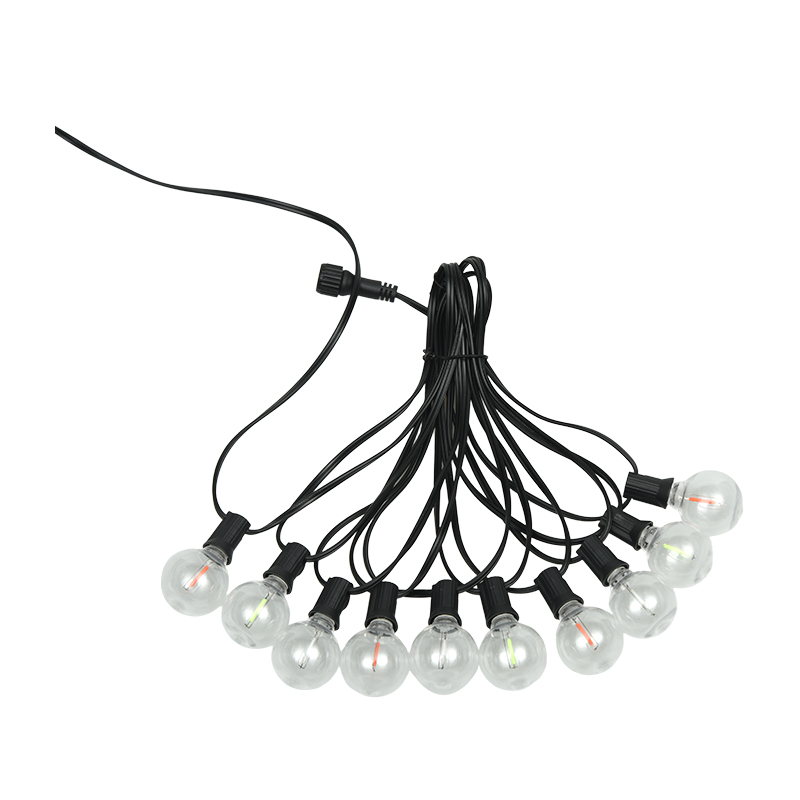
G40 Clip-on E12 Spiral Colored String Lights
-
 View More
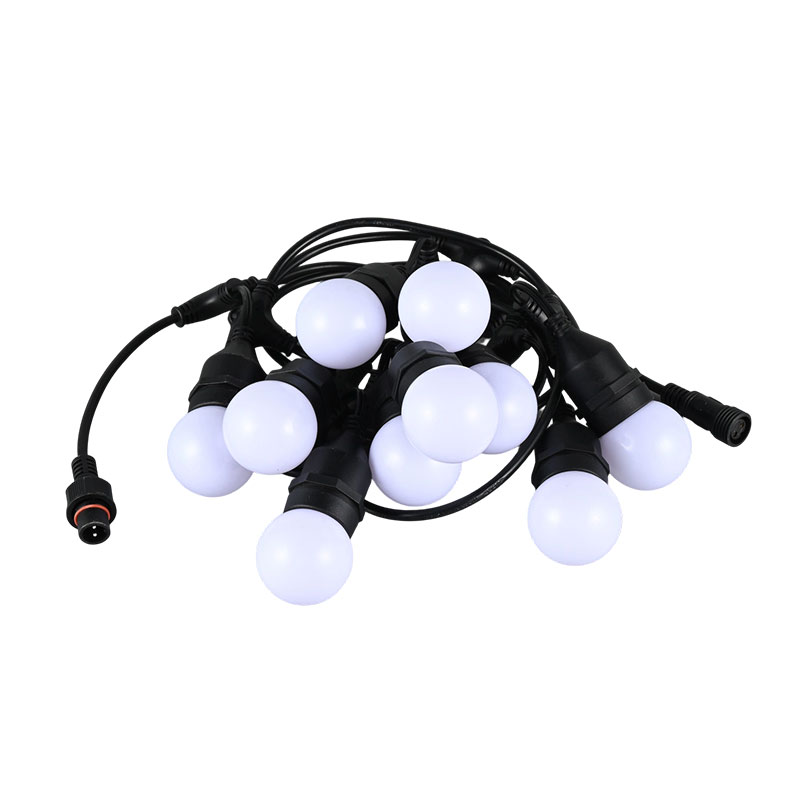
G45 Hanging Type E27 Spiral RGB Synchronized Flashing String Lights
-
 View More
C45 Hanging Type E27 Spiral RGB Synchronized Flashing String Lights
-
 View More
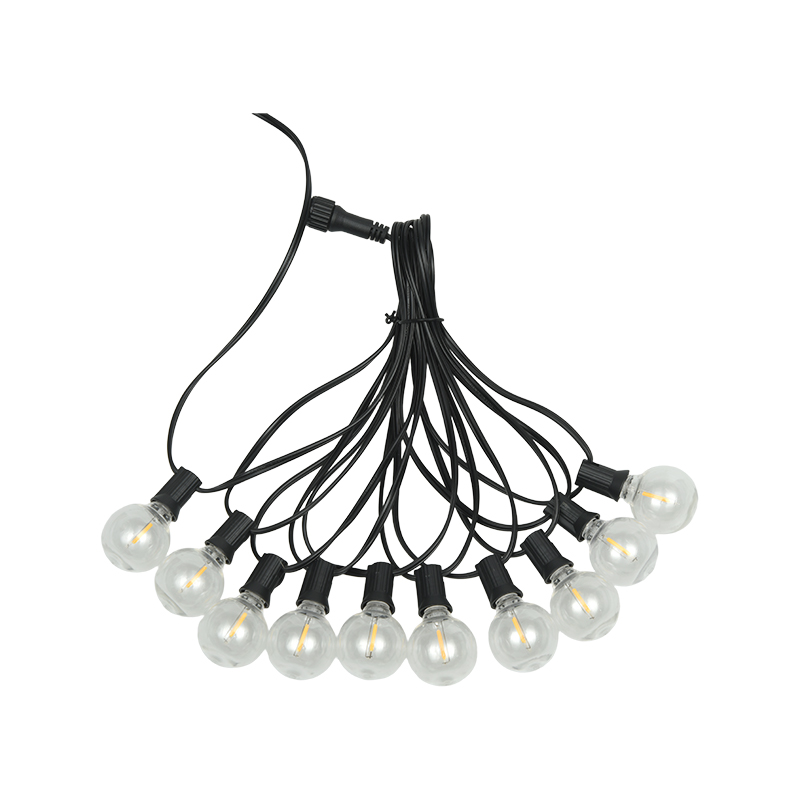
G40 Clip-on E12 Spiral Warm White String Lights
-
 View More
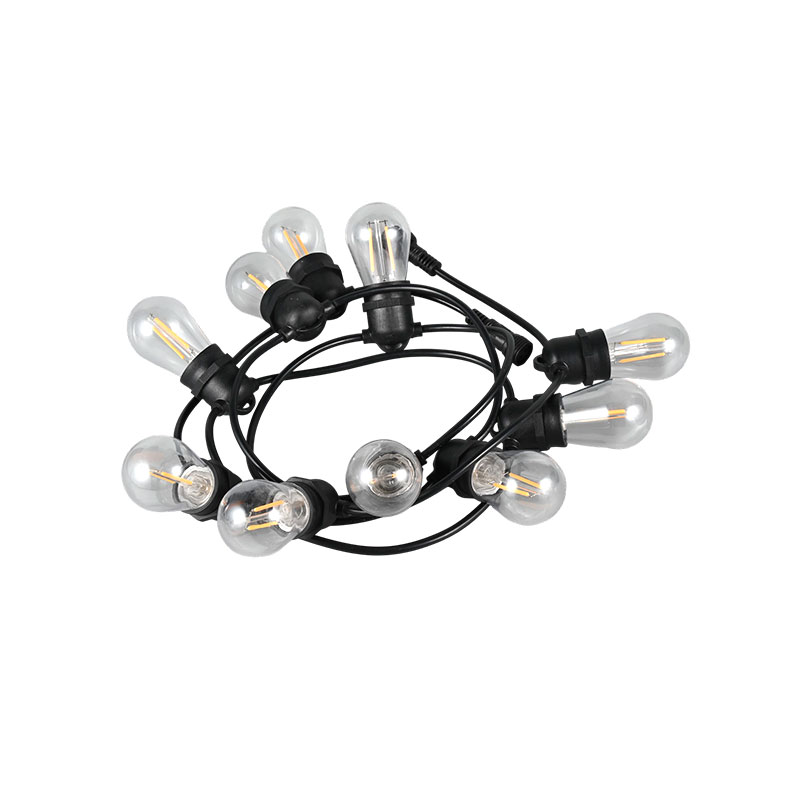
S14 Outdoor E27 Warm White String Lights
Hengboyi are always ready to help you and answer your question if you need.
Request A Quote
Contact Info.
 Mob: +86-13901119074
 Tel: +86-574-62838966
 E-mail: sale2@hengboyi.com
 Add: No. 18 Rongchuang Road, Mingwei Village, Lizhou Street, Yuyao City, Ningbo, Zhejiang Province, China
Quick Links
Product List
QR CODE
Copyright Ningbo Hengboyi Lamp Co., Ltd. All rights reserved.
China best outdoor decorative solar lights Manufacturer
Custom decorative string lights indoor Factory

